Personal context comes first
The same image can mean safety, fear, nostalgia, or nothing important depending on your history and recent experiences.
Dreams can carry personal meaning, but science has not found a universal dictionary that turns every symbol into one fixed message. The strongest approach combines sleep science, emotional context, recent memory, and your own associations.
Short answer
Do dreams have meaning? Sometimes they do, especially as reflections of current emotions, concerns, memories, expectations, and sleep conditions. A dream about missing a train may connect to pressure or lost timing for one person, while for another it may simply reuse a recent travel memory. Meaning depends on the dreamer and the context.
Researchers still debate exactly why we dream. Major explanations include memory consolidation, emotional processing, threat simulation, creative association, and the brain's effort to organize spontaneous activity during sleep. These explanations can overlap; one dream may contain pieces of several processes rather than one hidden message.
The practical conclusion is moderate. Treat a dream as information worth exploring, not proof of the future, a diagnosis, or an instruction you must follow. Start with what happened recently, how the dream felt, and what the images mean to you personally.

The same image can mean safety, fear, nostalgia, or nothing important depending on your history and recent experiences.
The feeling that remains after waking can reveal the concern your mind was rehearsing or processing.
Dreams can include random fragments, distorted memories, and ordinary sleep effects alongside personally meaningful material.
Dream research supports cautious possibilities, not a universal codebook.
| Observation | Reasonable interpretation | What it does not prove |
|---|---|---|
| A dream repeats during a stressful period | A persistent concern or emotional pattern may be receiving repeated attention. | That the dream predicts an event or has one fixed symbol meaning. |
| A recent conversation appears in a dream | The sleeping brain may be integrating recent memory with older associations. | That the other person is secretly thinking the same thing. |
| A nightmare causes strong fear | Stress, trauma reminders, illness, medication, or disrupted sleep may be relevant context. | That the feared event will happen in waking life. |
| A dream produces a creative idea | Loose associations during sleep can combine information in a novel way. | That every dream contains a hidden solution. |
| A dream seems completely random | Some content may reflect spontaneous brain activity or weakly connected memory fragments. | That the entire dream is meaningless or that every detail must be decoded. |
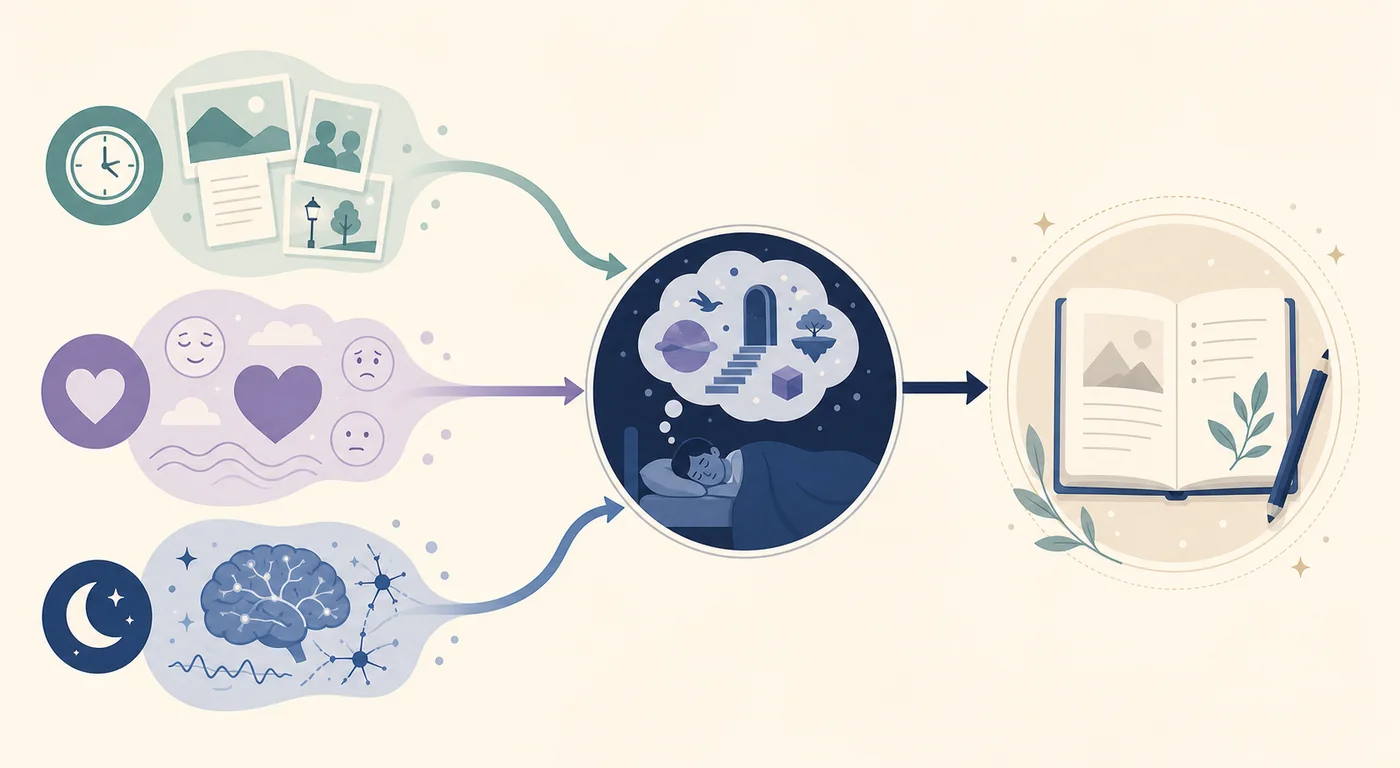
These theories are not mutually exclusive, and no single theory explains every dream.
During sleep, the brain strengthens, reorganizes, and connects memories. Dream scenes may borrow people, places, and fragments from recent and older experiences.
Example: A work deadline blends with a childhood classroom because both are linked to evaluation and pressure.
Dreams may help the mind revisit emotionally important material in a different state. The emotional pattern can be more informative than literal imagery.
Example: Being unable to speak in a dream may mirror helplessness in a difficult conversation without predicting anything.
Some theories suggest dreams simulate danger, conflict, escape, or social problems so the brain can rehearse responses without real-world risk.
Example: A chase dream may reflect generalized pressure rather than a literal person or threat.
The sleeping brain receives unusual internal signals and may weave them into a narrative. This helps explain abrupt locations, impossible events, and mixed identities.
Example: A random sound, body sensation, and old memory become one strange story that has no single symbolic key.
Use the dream as a reflection prompt, then test the interpretation against waking life.
Record the sequence, people, places, actions, and ending. Separating observation from interpretation reduces the temptation to force a favorite theory onto missing details.
Choose one or two feelings such as fear, relief, embarrassment, grief, desire, anger, or curiosity. Ask where that emotional pattern appears in current life.
Review the previous few days for conversations, media, travel, deadlines, conflict, sleep loss, illness, alcohol, or medication changes that could have supplied material.
Ask what the central image means to you before consulting a dictionary. A dog may represent comfort to one person and fear to another.
Write a tentative interpretation using words such as may, could, or perhaps. A useful interpretation should clarify a real concern, not create panic or certainty without evidence.
Important limits
Dream reflection can help you notice emotions, recurring worries, values, relationship patterns, and unresolved decisions. It can also support journaling or a conversation with a therapist when the dream connects to a broader issue. The benefit comes from the questions the dream raises, not from treating symbols as objective test results.
Be cautious with claims that one image always means pregnancy, betrayal, death, money, or a supernatural warning. Culture and personal experience influence associations, and online dictionaries often hide uncertainty behind confident language. A balanced explanation should offer possibilities and invite context.
Seek professional support if nightmares are frequent, cause fear of sleep, follow trauma, or seriously affect daytime functioning. Sudden changes in dreaming may also be worth discussing with a clinician when they appear alongside medication changes, illness, or major sleep disruption. Dream interpretation is not a substitute for medical or mental-health care.
Overview of dream theories, sleep stages, recall, and common questions.
Clinical explanation of possible functions and limits of dream interpretation.
Background on sleep stages, REM sleep, and brain activity during sleep.
Prefer explanations that stay grounded, personal, and testable.
| Better interpretation | Warning sign | Safer rewrite |
|---|---|---|
| Connects the dream to recent events and emotions | Claims a universal symbol predicts the future | Describe two or three possible meanings and check which fits your life |
| Uses tentative language | Presents a diagnosis or certainty | Treat the dream as a clue for reflection, not medical evidence |
| Respects cultural and personal associations | Ignores the dreamer's own history | Ask what the image has meant in past experiences |
| Suggests calm next steps | Creates fear, guilt, or urgent pressure | Journal, rest, discuss the concern, or seek qualified support when needed |
Probably not in the sense of a hidden message that must be decoded. Some dreams may reflect emotions and memories, while other details may come from spontaneous activity, body sensations, or loosely connected fragments.
There is no reliable scientific method showing that ordinary dreams predict future events. Dreams can rehearse worries and possibilities, which may later feel predictive when a similar event happens.
Strong emotion, vivid imagery, personal relevance, and waking during or near a dream can make it memorable. The mind also naturally searches for patterns and explanations.
They may reflect a repeated stressor, emotional theme, learned fear, or recurring sleep disruption. Compare what stays the same, what changes, and what is happening in waking life.
Use it as a source of possibilities, not as a final answer. Your personal association, culture, recent experiences, and emotion are usually more important than a universal symbol definition.
Consider qualified support when nightmares are frequent, follow trauma, cause fear of sleep, or interfere with daytime functioning. A clinician can assess sleep, stress, medication, and health factors.