GUIDE Dream patterns • Sleep • Reflection

Types of Dreams: Lucid, Vivid, Recurring & More

Dreams can be ordinary, vivid, lucid, recurring, stressful, or frightening. This guide compares the main types of dreams, explains what makes them different, and keeps interpretation grounded in sleep, emotion, memory, and personal context.

Short answer

What are the main types of dreams?

There is no single official list that explains every dream. In everyday sleep education, people usually group dreams by how they feel or repeat: ordinary dreams, vivid dreams, lucid dreams, recurring dreams, stress dreams, and nightmares. One dream can fit more than one group, such as a vivid recurring nightmare.

The label describes the dream experience, not a guaranteed message. A lucid dream means you notice that you are dreaming; it does not automatically predict anything. A nightmare is a frightening dream that may disturb sleep, while a recurring dream is defined by a repeated pattern rather than by one universal symbol.

Use the type as a starting point. Record the scene, the strongest emotion, what changed in your sleep or waking life, and whether the pattern repeats. Then choose a cautious interpretation that helps you reflect without turning a dream into a diagnosis, prophecy, or command.

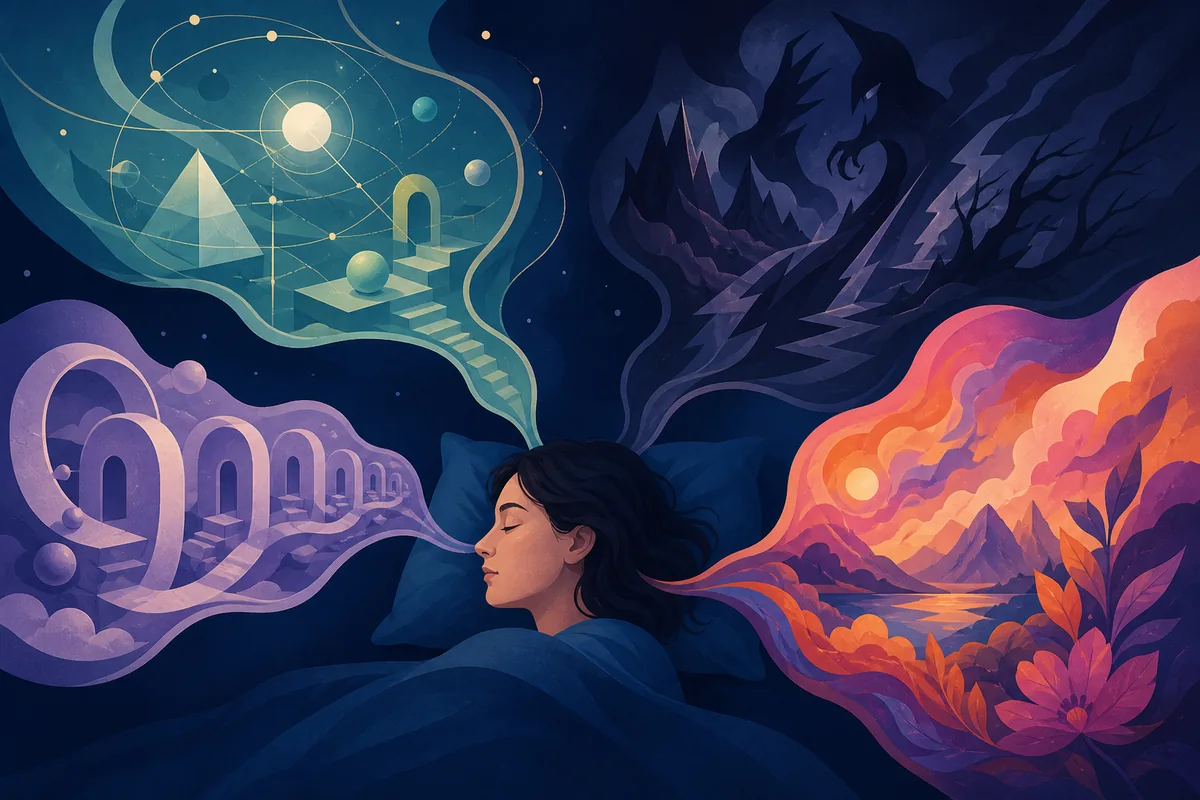
Sleeping person surrounded by four calm dream pathways representing different types of dreams
Dream types describe the experience and pattern of a dream; they do not automatically tell you one fixed meaning.

The fastest way to tell dream types apart

1

Lucid dreams

You recognize that you are dreaming while the dream is happening. Some people can influence the scene, but control is not required.

2

Vivid dreams

The images, sounds, emotions, or body sensations feel unusually clear and are easier to remember after waking.

3

Recurring dreams

A scene, storyline, emotion, or problem returns across nights. The repeated pattern matters more than a fixed dictionary symbol.

4

Nightmares and stress dreams

Fear, threat, pressure, or helplessness dominates the dream. Frequent distressing nightmares deserve attention as a sleep concern, not only symbolic analysis.

Common dream types at a glance

Use the pattern and the waking context together instead of assigning one meaning to every image.

Dream type What makes it distinct Useful next question
Ordinary or narrative dream A story-like dream with people, places, memories, or imagined events that may fade quickly. What feeling or recent experience stayed with you?
Vivid dream Strong sensory detail or emotion makes the dream feel unusually real and memorable. Did you wake near the dream or sleep more lightly than usual?
Lucid dream You become aware that you are dreaming, sometimes with partial influence over what happens. Did awareness feel calm, exciting, confusing, or frightening?
Recurring dream A similar scene, conflict, setting, or emotional pattern returns over time. What has changed between episodes, and what has stayed the same?
Stress dream Pressure, deadlines, conflict, being unprepared, or losing control shapes the story. What current demand feels unresolved or difficult to contain?
Nightmare A frightening dream causes distress or wakes you with fear, sadness, anger, or physical arousal. Is it occasional, repeated, trauma-linked, or affecting daytime life?
Editorial comparison of lucid, nightmare, recurring and vivid dream experiences
A practical dream journal separates how a dream feels from what the dream may mean in your personal context.

What different dream types may show

These are reflection hypotheses, not universal definitions. The same type can have different causes for different people.

Ordinary narrative dreams

Many dreams combine recent memories, familiar people, unfinished tasks, and imaginative changes. They may not need a deep interpretation. The most useful clue is often the emotion that remains after the details fade.

Example: A dream about returning to school before a presentation may reflect evaluation pressure, even if the school itself is not important.

Vivid dreams

A vivid dream can feel meaningful because you remember it with unusual color, dialogue, movement, or body sensation. Strong recall may be related to waking near a dream, lighter sleep, stress, illness, or a changed routine.

Example: A detailed ocean scene after several short nights may tell you as much about sleep timing as it does about emotion.

Lucid dreams

Lucid dreaming involves awareness during the dream. Some people explore the scene, practice a skill, or wake themselves up; others simply notice the dream and let it continue. Lucidity is an experience, not proof of a hidden prediction.

Example: Realizing you are dreaming while flying may feel empowering, but the personal meaning depends on your emotions and waking situation.

Recurring dreams

Recurring dreams may repeat a setting, relationship, threat, decision, or emotion. Repetition can invite reflection on an unresolved concern, but it can also be connected to stress, sleep disruption, trauma, or a learned dream pattern.

Example: A repeated dream of missing a train may be worth comparing with current pressure, timing, and fear of losing an opportunity.

Stress dreams

Stress dreams often use ordinary problems in exaggerated ways: arriving unprepared, being chased, losing a phone, failing a test, or being unable to speak. They can be a prompt to notice pressure rather than a forecast of failure.

Example: A dream about a room filling with water may reflect overwhelm, but first check whether stress or poor sleep has recently increased.

Nightmares

Nightmares are frightening dreams that can interrupt sleep and leave strong distress after waking. Occasional nightmares are common. Repeated nightmares that cause fear of sleep, daytime impairment, or physical acting out deserve professional attention.

Example: A single chase nightmare can be reflected on gently; a recurring trauma-related nightmare may need care beyond a symbol dictionary.

How to interpret a dream type without overreading it

Start with the experience, then add the scene and your waking context.

Step 1: Name the type and the strongest emotion

Write one label such as vivid, lucid, recurring, stressful, or nightmare, then record the emotion that lasted longest. Fear, relief, grief, curiosity, and confidence can point in different directions.

Step 2: Separate sleep clues from symbolic clues

Note short sleep, repeated awakenings, illness, travel, alcohol changes, medication changes, stress, or intense media. Practical sleep factors can affect dream intensity and recall.

Step 3: Describe the pattern before the symbols

Ask who was present, what changed, whether you had control, and whether the story has appeared before. This prevents one object from carrying the entire interpretation.

Step 4: Compare one relevant guide

If the dream also includes water, snakes, falling, a person, or teeth, use the matching guide for that specific scene. Keep the broader dream type as the frame.

Step 5: Choose a grounded next step

A next step might be a journal note, a calmer bedtime routine, a conversation, or professional support. Do not let a dream replace evidence or make major decisions for you.

Sleep note

When dream patterns are normal and when to pay attention

Dreams vary naturally from night to night. Vivid recall can happen when you wake close to a dream, while recurring or stressful dreams may become more noticeable during difficult periods. A dream label is useful for organizing an experience, but it does not diagnose a sleep or mental health condition.

Pay closer attention when nightmares are frequent, make you avoid sleep, impair concentration, follow trauma, or involve physically acting out the dream. In those situations, the priority is sleep quality and safety. A qualified clinician can help you assess the pattern more reliably than a general dream dictionary.

This guide is for education and self-reflection. If a medicine change, illness, substance change, severe insomnia, or ongoing distress may be affecting your dreams, seek appropriate professional advice and do not change prescribed treatment on your own.

Helpful references

Sleep Foundation: Dreams

Plain-language background on dreams, REM sleep, dream recall, and why dream experiences vary.

Sleep Foundation: Lucid Dreams

Overview of dream awareness and common lucid-dream experiences.

Cleveland Clinic: Nightmare Disorder

Medical guidance for repeated nightmares that cause distress or daytime impairment.

How an AI dream interpreter can help

Use AI to organize a full dream description, not to turn a type label into a diagnosis or prediction.

Situation What AI can organize What you still decide
A vivid or unusual dream The scene, emotions, people, symbols, and possible waking-life connections. Whether sleep timing or a recent stressor explains much of the intensity.
A recurring dream Repeated settings, changes between episodes, and the central emotional pattern. Whether journaling, a conversation, or professional support is the right next step.
A nightmare The threat pattern and context for gentle reflection. Whether the frequency, trauma link, or daytime impact calls for clinical help.

Types of Dreams FAQ

How many types of dreams are there?

There is no universally accepted number. Common practical categories include ordinary narrative dreams, vivid dreams, lucid dreams, recurring dreams, stress dreams, and nightmares. A single dream can fit more than one category.

What is the difference between a vivid dream and a lucid dream?

A vivid dream is unusually clear or memorable. A lucid dream is one in which you realize that you are dreaming while it is happening. A dream can be both vivid and lucid, but vividness does not require awareness.

What do recurring dreams mean?

Recurring dreams may reflect a repeated concern, emotion, routine, memory, or sleep pattern, but there is no one meaning that applies to everyone. Compare what changes and what stays the same across episodes before interpreting it.

Are nightmares a normal type of dream?

Occasional nightmares are common and may follow stress, frightening content, illness, or ordinary variation in sleep. Repeated nightmares that disturb sleep or daytime life deserve more attention than a symbolic reading alone.

Do all dreams have a hidden meaning?

Not necessarily. Dreams can combine memory fragments, emotion, imagination, and sleep-related brain activity. Treat interpretation as a reflection exercise, not proof that every image contains a fixed message.

Can AI identify what type of dream I had?

AI can help organize your description around features such as awareness, vividness, repetition, fear, and emotional tone. It cannot diagnose a sleep disorder or prove a prediction, so keep the result as a starting point for reflection.